|
|
DenmarkFrom Researching Virtual Initiatives in Educationby Asger Harlung of Aarhus with specialist help from Ann Fastré For entities in Denmark see Category:Denmark
Partners and Experts in DenmarkAarhus University is partner in VISCED. Denmark in a nutshell The Kingdom of Denmark (Danish: Kongeriget Danmark), commonly known as Denmark, is a country in the Scandinavian region of northern Europe. Its capital is Copenhagen, it is 43,098 km² or 16,639² sq mi wide with a population of 5,564,219* people) , who we call the Danish or the Danes. The official language is Danish, which is close to Swedish and Norwegian with which Denmark has strong cultural and historical ties. Denmark is a constitutional monarchy with a parliamentary system of government. Denmark's Constitution originated in the chieftain rule of the Viking Age, it was Absolute Monarchy, followed by Enlightened Absolutism 1660-1848. In 1848, the new King Frederik VII abolished Absolutism and the following year a free Constitution was codified. Source: Royal Danish Ministry of Foreign Affairs > Denmark - an Overview Relevant Documents:
Denmark has a state-level government and local governments in 98 municipalities. Denmark has been a member of the European Union (EU) (formerly European Economic Community) since 1973, although has not joined the Eurozone (the zone of countries which use the Euro). Denmark is a founding member of North Atlantic Treaty Organization (NATO).
*: April 2011 estimate according to the Statistics Denmark **: January 2011 statistics from the Danish Church Ministry Adapted from: the Wikipedia page on Denmark and Denmark.dk > About Denmark Note: also available is an interactive map of Denmark where you can hover over the cities and make the public transport routes visible
Denmark consists of 443 islands and in 2007 the country created the division of five regions and a total of 98 municipalities, which mostly have a population of at least 20,000 people. This division was a part of the 2007 Danish Municipal Reform to replace the country's traditional thirteen counties (amter). At the same time, smaller municipalities (kommuner) were merged into larger units, cutting the number of municipalities from 270 to 98. The most important area of responsibility for the new regions is the national health service.
The Faroe Islands and Greenland/Grønland are autonomous provinces of Denmark with home rule, but are not members of the European Union (EU). Adapted from:
Education in DenmarkThe Danish education system provides access to primary school, secondary school, and most kinds of higher education. Attendance at "Folkeskole" is compulsory for a minimum of 9 years, and a maximum of 10. About 99% of students attend compulsory elementary school, 86% attend secondary school, and 41% pursue further education.
Danish education policy
We can say that the key values in Danish education are intellectual liberty, equality and democracy. In 2007 the Danish government decided to strengthen the public's knowledge of the democratic values on which the Danish society is founded by creating a democracy canon. The canon has now been translated into English." --> The Danish Democracry Canon (EN). Read the complete Danish Democracry Canon (EN).
Education levels in DenmarkA. Primary and secondary education Danish primary and lower secondary education is based on the Danish Education Act. In its introduction, it states the following about the aims of primary and lower secondary education: Section 1. Together with parents, primary and lower secondary school shall provide pupils with knowledge and skills that: prepare them for further study and give them the desire to learn more, make them familiar with Danish culture and history, provide them with an understanding of other countries and cultures, contribute towards their understanding for man's interaction with nature and promote the individual student's all-round development. Section 2. Primary and lower secondary school must develop working methods and create a framework that promotes experience, absorption and enterprise so that students develop their imagination, sense of recognition and self-belief, thus enabling them to take a position and act. Section 3. Primary and lower secondary school shall prepare the students towards participation, joint responsibility, rights and duties in a free and democratic society. School activities must thus be characterised by intellectual liberty, equality and democracy. Source: New to Denmark - School and education The Folkeskole is the Danish municipal primary and lower secondary school and consists of:
Education is compulsory in Denmark for everyone between the ages of 6-7 and 16: so nine years of basic education. It is important to note that education itself is compulsory, not schooling: whether the education is received in a publicly provided school, in a private school or at home is a matter of individual choice, as long as accepted standards are met.
Source: Denmark.dk > Denmark: an Overview > Education
Institutions of higher education in Denmark have a long tradition of academic freedom and autonomy. The Ministries lay down the overall regulations for all institutions of higher education. These include regulations concerning the admission of students, the structure of studies, programmes offered, awarding of degrees and appointment of teachers and academic staff. The individual institutions draw up and update their study programmes, indicating the aims, scope and duration, form and contents of the courses, as well as a description of the syllabus. Technical colleges, business colleges and agricultural colleges are independent institutions under the overall authority of the Ministry of Education. Social and health care colleges are run by the county authorities. The labour market training centres (AMU-centre) are administered by the Ministry of Education. As of December 2001, the Ministry of Science, Technology and Innovation is responsible for university education except for certain higher education programmes, which fall under the responsibility area of the Ministry of Cultural Affairs (e.g. architecture, music, fine arts, librarianship). The Ministry of Education oversees short- and medium-cycle higher education, in most cases. Source: CIRIUS Online - General organisation of the Danish education system The Act on Tertiary Artistic Education Institutions under the Auspices of the Ministry of Culture stipulates which institutions the Ministry of Culture has authority over, their missions, their programmes and management. (The Act No. 289 of April 27, 1994 was amended by Act No. 142 of March 17, 1999. and consolidated by Consolidation Act No. 889 of September 21, 2000 (in force)) Source: Act on Tertiary Artistic Education Institutions under the Auspices of the Ministry of Culture The Act on Universities and Other Institutions of Higher Education / The University Act about degrees:
Source: VTU - Act on Universities - Part 2. Degree Programmes, Paragraph 6 (EN - PDF), p.2 Relevant Documents:
The strategy for lifelong learning includes the following objectives:
Source: Danish Ministry of Education - Objectives for lifelong learning In spring 2007 the Government drew up a report concerning Denmark’s strategy for lifelong learning as part of European cooperation on education. This constitutes the Government’s contribution to the realisation of the common goals in the Lisbon strategy. The strategy covers the development of all forms of education, learning and lifelong skills upgrading for all – in the education system, in adult education and continuing training, at work and in the many other settings in which people learn and develop their knowledge, skills and competences. The Government’s globalisation strategy focuses in particular on training and lifelong skills upgrading. A high level of educational attainment and good opportunities for lifelong learning are among the most important preconditions for strong competitiveness and for everyone to be able to actively participate in the labour market and in society. It is the Government’s aim that Denmark shall have world-class education and that everyone shall participate in lifelong learning. Sources:
The government also set up the Tripartite Committee on lifelong skills upgrading and education and training for all in the labour market / Trepartsudvalget om livslang opkvalificering og uddannelse for alle på arbejdsmarkedet. Related Documents:
Legislation on education, building, employment and public transport today includes provisions laying down the responsibility of the sector for people with disabilities. The principle of sector responsibility is part of the parliamentary resolution on equal opportunities of 1993 (B43). Source: The Equal Opportunities Centre for Disabled Persons) / Center for Ligebehandling af Handicappede - Danish disability policy (EN - online) Relevant Documents:
Relevant document: Denmark (2007/08) - Legislation (EN), also in PDF, containing references to educational Acts in Denmark.
Schools in DenmarkPrimary school in Denmark is called "den Danske Folkeskole" ("Danish Public School"). It runs from 1st to 10th grade, though 10th grade is optional, as is the introductory "kindergarten class" ("børnehaveklasse"). Students can alternatively attend "free schools" ("Friskole"), or private schools ("Privatskole"), i.e. schools that are not under the administration of the municipalities, such as Christian schools or Waldorf Schools. The Programme for International Student Assessment, coordinated by the OECD, ranked Denmark's education as the 24th best in the world in 2006, being neither significantly higher nor lower than the OECD average.
Gymnasium, HF, HTX and HHX aim at qualifying students for higher education in universities and colleges. Folkehøjskolerne, ("Folk high schools") introduced by politician, clergyman and poet N.F.S. Grundtvig in the 19th century, are social, informal education structures without tests or grades but emphasising communal learning, self-discovery, enlightenment, and learning how to think. Source of these excerpts: Wikipedia page on Denmark’s Education Students receive points according to a 7-point grading scale:
Source: Ministry of Education - 7-point grading scale and the Marking Scale in the Danish Education System
Higher education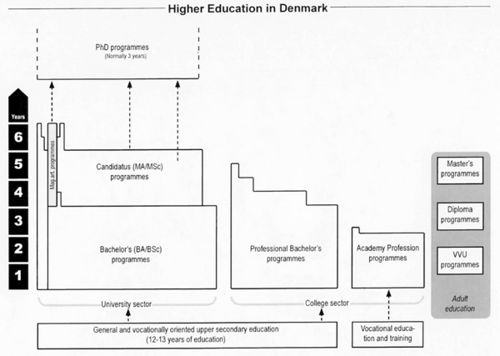 Higher education institutions in Denmark can be divided into 3 main categories:
Source: Study in Denmark Background
Professionally oriented higher education programmes are offered at colleges. Whereas in other countries, similar programmes may be offered by universities, in Denmark they have traditionally been offered by specialised colleges. Very often these institutions are engaged in theoretical and practical developmental work, and many of them participate in international cooperation, e.g. through the EC mobility programmes. Source: CIRIUS Online - Higher Education – The College Sector and Source: CIRIUS Online - Higher Education – College Education
Universities Denmark / Danske Universiteter is the association of the Danish research universities and its purpose is to enhance their collaboration and the visibily of the university sector in Denmark and abroad. Source: their web site (DK) with English Publications.
Universities in DenmarkThere are 8 Universities:
Polytechnics in DenmarkThe word "polytechnic" is now no longer used in Denmark. This subsection will instead list university colleges, academies of professional higher education, and university level schools of arts.
University Colleges in DenmarkThere are 10 University colleges:
Academies of Professional Higher Educations in DenmarkThere are 9 Academies of Professional Higher Education:
University Level Academies and Colleges of Arts in DenmarkThere are 13 University-level academies and colleges of arts:
Other Higher Educational InstitutionsThere are other HEIs not listed by The Danish Agency for International Education on the Study in Denmark homepage:
Education reformSchoolsThis section needs content.
Post-secondaryHigher education reformBachelor – Master – PhD degrees
Source: CIRIUS Online - Higher Education The Bologna ProcessSubsequent legislation has established the structure based on two main cycles in all university disciplines. The most recent arrangements in this context and linked to the Bologna process are specified in the Ministry of Science, Technology and Innovation's Order No. 338 of 6 May 2004 on university Bachelor's and Master's programmes, which was issued under the Universities Act of May 2003, and the June 2004 Ministry of Culture Order on education in the academies of music and the Opera Academy. Source: CIRIUS Online - Higher Education - Background The Bologna Follow-up Group In Denmark, the Bologna Process covers education programmes and institutions under several ministries, each of which are responsible for the implementation of the process within their ministerial jurisdictions. It has also been a goal to fully include the ministries’ professional agencies, education institutions and organisations in the implementation process. Therefore, the implementation process is led by a steering group – the Bologna Follow-up Group –, which has the following members: Ministry of Science, Technology and Innovation (chairmanship), Danish Ministry of Education, Danish Ministry of Culture, Danish Evaluation Institute (quality assurance agency for international education programmes), CIRIUS Danmark (including Assessment of Foreign Qualifications), Danish Rectors’ Conference "Universities Denmark", Danish Association of Institutions in Higher Education (DAN-EURASHE), Danish Confederation of Professional Associations and the National Union of Students in Denmark
Source: Implementation of the Bologna Goals in Denmark (PDF, EN, 6 pages), 2003
Administration and financeSchoolsThis section needs content.
Post-secondaryA. Funding for HEIs The self-governing HEIs have two sources of revenue for financing their educational programmes: state grants and their own income from income-generating activities, participant fees and fees paid for unemployed people in activation programmes, etc. The state grants amount to approximately 80 per cent of the total funding and are thus the primary source of revenue for the institutions. Of this amount, activity-level determined grants (teaching, building and maintenance, or collective expenses taximeters) total approximately 92 per cent, so that by far the greatest part of state funding consists of taximeter funding. The Ministry of Education is responsible for supervising institutions with income-generating activities. Source: The Taximeter System (EN), Danish Ministry of Education. The taximeter system has some advantages as it states direct demands on quantity and indirect requirements on quality in higher education, but it could be improved as the basic rates have been repeatedly cut during the last decade and secondly the system has been criticised for lack of balance and a clear rationale in the allocation of resources between the different educational areas. The second component of the funding system, the basic grants, is perceived as being of great importance to the budget security of institutions and to enabling them long-term planning, enabling flexibility and important for the quality and outcome of basic research. However, there is a lack of use of performance parameters which weakens incentive mechanisms and limits quality assurance, while a large share of basic grants is tied to co-financing of external projects which makes that the factual amount of free funds at HEIs is more limited than assumed. Finally there is also the third major component of the funding system, the external research grants. Criticism on this component is that it is often focused on areas that are too narrow in scope which makes that the grant does not promote originality, creativity and novelty.. Source: Funding Systems and Their Effects on Higher Education Systems - Country Study – Denmark (EN, PDF, 25 pages), November 2006
All Danes over the age of 18 are entitled to public support for his or her further education thus tuition at public and at most private educational institutions is free. Support for the student's living cost is awarded by the State Educational Grant and Loan Scheme (SU), which is a system managed by the Danish Educational Support Agency / Styrelsen for Statens Uddannelsesstøtte which operates under the auspices of the Ministry of Education. The purpose of the State Education Grant and Loan Scheme Act (danish acronym SU) is to make sure that as many young people as possible quickly receive a sound education. The State Education Grant and Loan Scheme is the Agency's oldest and largest area of activity, with some 300,000 beneficiaries. The Statens Uddannelsesstøtte is up to DKK 4,852 (approximately 651 EUR) per month, so that no one is precluded from further education because of social or economic status. .. As part of the efforts to increase the workforce, the state educational grant will be adapted to encourage quicker completion of studies. Local authorities and political educational associations offer extensive evening education opportunities for adults. Source: Denmark.dk > Denmark: an Overview > Education
Inside a maximum of 70 monthly grants, students can change from one programme to another. In combination with both types of grants, students are offered supplementary state loans and about half of all students make use of these state loans. For more information, visit www.su.dk. Students must start paying back state loans no later than one year after the end of the year in which they graduate or give up their studies. The loan must be repaid within 15 years. About half of all students make use of state loans. There is also the Act on Transportation Discount for Students Attending Institutions of Higher Education reduces transportation expenses for students who live far from the educational institution; they receive a Discount Transportation Card. Sources and related documents:
Folkeoplysning" (liberal education) and folk colleges - Special Needs:
Special needs education for adults: The Act on Special Education for Adults forms the legal basis for compensatory special education for adults with physical or intellectual disabilities. The programmes aim to compensate for the consequences of functional difficulties, by learning how to use certain tools or methods in every-day life. Source: "Folkeoplysning" (liberal education) and folk colleges There are different references to an Act regarding Special Needs, but according to the web site of the Agency, 800 people benefit from the compensations through an Act called theAct on Special Educational Assistance in Higher Education (Danish acronym SPS). Source: the Danish Educational Support Agency / Styrelsen for Statens Uddannelsesstøtte (EN) Relevant Documents:
Quality assurance, inspection and accreditationSchoolsThe Danish Evaluation Institute (EVA) In 1999, the Danish Evaluation Institute (EVA) / Danmarks Evalueringsinstitut was established “as an independent institution under auspices of the Ministry of Education. It assesses and develops education and childcare and is the national knowledge center in the field of evaluation. From an international point of view, this institution is quite unique, as it has been given the task to undertake systematic and mandatory evaluations of teaching and learning at all levels of the education system from pre-school to postgraduate level. In order to develop the quality of teaching and learning and to examine whether the educational sector lives up to the objectives laid down, the Evaluation Institute systematically examines the education programmes separately as well as the relations between different programmes. The institute also develops and innovates evaluation techniques and methods and compiles national and international experience with educational evaluation and quality development.” In 1999 the Act on The Danish Evaluation Institute was enforced, which empowers the Institute to initiate evaluations on its own initiative as well as at the request of the Ministry of Education, other ministries, advisory boards, local authorities and education institutions. Requested evaluations are conducted as revenue-generating activities. In spring 2005, the Swedish National Agency for Higher Education / Högskoleverket was entrusted with the task of externally evaluating EVA. More information on EVA: fact sheet The Danish Approach To Quality Assurance. CIRIUS Online - Qualifications frameworks CIRIUS is an authority within the Danish Ministry of Science, Technology and Innovation responsible for supporting the internationalisation of education and training in Denmark. It is the national agency for two EU education programmes, Lifelong Learning and Youth in Action, as well as for other similar programmes, including Nordic and Danish education programmes and initiatives. Furthermore, CIRIUS is also the central institution in Denmark where persons with foreign qualifications can get these assessed and recognised and the information centre concerning internationalisation of all the educational sectors. Denmark has had a national Qualifications Framework for Higher Education since 2003: Qualifications Framework 2003 (PDF). The framework has been widely implemented and used by institutions of higher education. In 2006, the relevant ministries took the initiative to begin a revision of the Qualification Framework (QF). Relevant Documents:
Post-secondaryThe University Act prescribes internal evaluations at the universities, initiated and supervised by the Study Boards of the respective departments. The frequency of the internal evaluation is not regulated by law, but in overall terms the particular subjects/courses are evaluated by the end of each semester. Self-completion questionnaires to be filled in by the students represent the predominant way of collecting data for the internal evaluations. Foreign Qualifications are also handled by CIRIUS where students can find information on two different pages: How to get an assessment of your qualifications and Use your Danish qualifications abroad.
Information societyTowards the information society"In Denmark two initiatives have been taken to encourage the use of ICT in education in general, and in open education in particular:
Source: FLUID – national report Denmark 2003, PDF - 36 pages, which also lists the main features and the obstacles of ODL in Denmark: Discussion of the main features, Blended Learning, Action Learning , Group/team work, The tutor/teacher in ODL – an obstacle of the mind, The Learners, Drop-out rates, The lack of support from the management, Learning materials.
Information society strategyThe National IT and Telecom Agency is responsible for central parts of the Government's IT and telecommunications policy (EN) and is part of the Ministry of Science, Technology and Innovation (VTU). It published the Danish report: National strategy for ICT-supported learning - Efforts to promote the use of ICT-supported learning (DK), 2007 (news article or whole online publication (DK)): "The aim of the strategy is to increase the use and quality of e-learning to reinforce skills development broadly and to make Denmark a leading country in e-learning."
The National IT and Telecom Agency published Key figures on Information society Denmark (EN) from 2005 onwards including Key Figures on the Danish Information Society 2007 (EN - PDF - 74 pages, 2007) which tells us that in 2006, about 83 per cent of the population had access to the Internet from home. The Key figures report also shows a graphic of the private use of the Internet for courses and education was 19% as a maximum.
ICT in education initiativesVirtual initiatives in schoolsThis section needs content.
Virtual initiatives in post-secondary educationThe Virtual Campuses in Danish Higher Education are listed on a separate Re.ViCa wiki page called Virtual Initiatives in Denmark
Lessons learntGeneral lessonsNotable practicesReferences
>> Main Page |